The Occult Meaning of Mirrors: Symbolism, Folklore and Spiritual Uses
The Occult Meaning of Mirrors: Symbolism, Folklore and Spiritual Uses
Mirrors have always held a certain quiet drama. They show us our faces, of course, but in occult and spiritual traditions they are often seen as far more than household objects. The occult meaning of mirrors usually centres on reflection, hidden truth, duality, thresholds and the idea that something unseen may be waiting just beyond the surface.
If that sounds a little mystical, it is. But it is also surprisingly practical. People have used mirrors for centuries to reflect not just light, but meaning. They appear in folklore, divination, protective rituals and spiritual symbolism across many traditions. The important thing to remember is that mirror lore is not one single rulebook. Meanings vary, and context matters.
In short: in occult traditions, mirrors often symbolise truth, self-knowledge, shadow aspects of the self, spiritual boundaries and, in some practices, a doorway for divination. They are not universally seen the same way everywhere, but they are rarely treated as ordinary objects.
What Is the Occult Meaning of Mirrors?
At its simplest, the occult meaning of mirrors is about reflection with an extra layer of mystery. In esoteric thought, a mirror can represent the visible self and the hidden self at the same time. It shows what is there, but also invites questions about what is not immediately obvious.
That is why mirrors often appear in spiritual writing as symbols of truth, self-examination and revelation. They can suggest honesty, but not always comfortable honesty. A mirror does not flatter; it reflects. Spiritually speaking, that makes it a rather useful little truth-teller.
Why Mirrors Matter in Spiritual and Esoteric Traditions
Mirrors sit at the meeting point of light, image and illusion. That makes them especially interesting in occult symbolism. They can suggest:
- Reflection: seeing yourself clearly, both outwardly and inwardly.
- Duality: the idea that we all contain contrasting aspects.
- Thresholds: a boundary between the known and the unknown.
- Hidden knowledge: insight that is not immediately visible in daily life.
- Self-awareness: the courage to examine your own patterns.
In spiritual psychology, mirrors are sometimes linked to the shadow self — those parts of the personality we may ignore, deny or simply not notice. That does not mean anything sinister. It means mirrors can remind us that growth often begins with honest self-recognition.
Common Symbolic Meanings: Truth, Self-Reflection, Duality, Portal
Different traditions emphasise different meanings, but a few themes come up again and again.
Truth and clarity
Mirrors are often associated with seeing things as they really are. In an intuitive sense, they can stand for clearer judgement, less self-deception and the willingness to face reality kindly.
Self-reflection
This is the most natural symbolic meaning. A mirror invites pause. It asks: what am I showing the world, and what am I not yet acknowledging in myself?
Duality
Because a mirror creates an image that is both the same and reversed, it often symbolises opposites: light and shadow, outer and inner, visible and hidden.
Portal or threshold
Some occult and folk traditions treat mirrors as a kind of threshold. This does not have to be taken literally. More often, it reflects the feeling that mirrors mark a boundary between ordinary perception and a more symbolic or spiritual one.
Mirrors in Folklore and Superstition
Folklore around mirrors is rich, varied and delightfully peculiar. In some cultures, mirrors are covered after a death to prevent spirits from being disturbed or to honour the mourning process. In other traditions, mirrors are linked to soul-image beliefs, or to the idea that reflective surfaces can attract attention from beyond the physical world.
Broken mirror superstition is one of the best-known examples. In folklore, a broken mirror can symbolise bad luck or a disruption of harmony. Yet this is best understood as a cultural belief rather than a universal occult law. Many spiritual practitioners would say the meaning depends on your tradition, your intention and the context of the event.
Likewise, mirror rules differ widely. Some people see a mirror facing the bed as unsettling, while others simply consider it poor feng shui or a distracting placement. The point is not to become frightened of every reflective surface in the house. It is to notice how strongly humans have always felt that mirrors carry symbolic weight.
Mirrors in Divination and Scrying
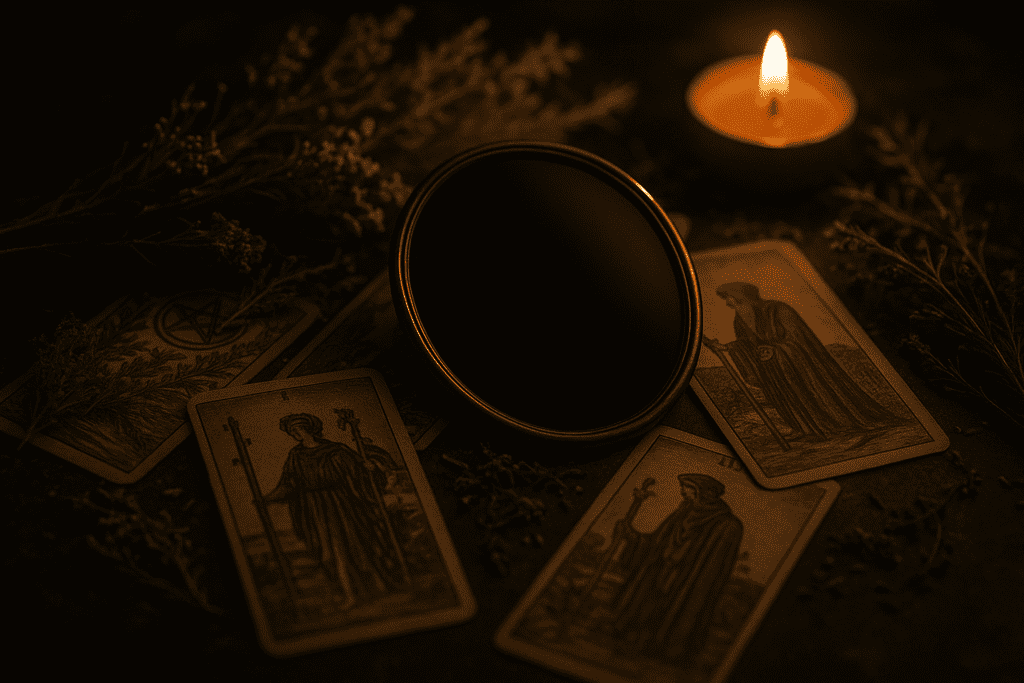
One of the most direct occult uses of mirrors is scrying. This is the practice of gazing into a reflective surface — often a black mirror, dark bowl of water or polished glass — in order to receive impressions, images or intuitive insight.
In scrying, the mirror is not treated as a magic answer machine. It is more like a focus point that helps quiet the ordinary mind so that subtle impressions may emerge. Some people use it for meditation, others for symbolic divination. As with tarot, the experience can be deeply personal and interpretive rather than fixed and literal.
A black mirror is especially associated with this practice because its dark surface reduces distraction and invites inward focus. Again, the mirror is a tool, not a guarantee. What it offers is a space for reflection — in every sense of the word.
Broken Mirrors, Covered Mirrors and Other Common Beliefs
People often search for the meaning of specific mirror events, so it helps to separate symbolism from superstition.
- Broken mirror: often linked in folklore with bad luck, shattered harmony or disrupted reflection.
- Covered mirror: commonly associated with mourning, respect or spiritual protection in some traditions.
- Mirror facing a bed: sometimes seen as energetically restless or too active for a restful space.
- Seeing your reflection unexpectedly: may be interpreted symbolically as a reminder to pause and notice what you are feeling.
None of these meanings is universal. The spiritual meaning of mirrors is shaped by culture, belief system and personal intuition. That is why a calm, context-aware reading is usually more useful than a dramatic one.
What the Mirror Symbol Means Today
In modern spiritual life, mirrors still speak powerfully. They can remind us to check in with ourselves honestly, to notice our projections, and to stay curious about the parts of life we cannot yet fully define. For some people, mirrors feel protective. For others, they feel contemplative. Sometimes both at once.
If you are exploring mirror symbolism for your own life, a useful question is not, “What is the one true meaning?” but rather, “What is this mirror reflecting back to me right now?” That might be a relationship pattern, a choice you have been avoiding, or simply the need to be a bit kinder to yourself this week.
In that sense, the occult meaning of mirrors is less about spectacle and more about awareness. They ask us to look — and to keep looking — until we notice what has been waiting in plain sight.
Key Takeaway: Mirrors as Tools of Reflection and Mystery
Mirrors carry a rare sort of symbolism. They are ordinary enough to use every day, yet mysterious enough to inspire folklore, ritual and divination. Across occult traditions, they often represent truth, duality, self-knowledge and thresholds between states of awareness.
Whether you are studying mirror symbolism, curious about mirror magic, or simply wondering why mirrors have gathered so many stories around them, the answer is usually the same: they reflect more than appearances. They invite meaning.
Need a more personal answer? For guidance shaped around your own question, you can speak with one of Philip Garcia’s trusted psychic readers. Click on this link or call 0203 472 4377.
Disclaimer: Psychic and astrological content is provided for entertainment and personal insight. It should not replace professional medical, legal, financial or mental health advice.
Frequently Asked Questions
What is the occult meaning of mirrors?
In occult traditions, mirrors often symbolise reflection, truth, duality, hidden identity and the boundary between the known and unknown. They may also be used in divination practices such as scrying.
Are mirrors really seen as portals?
Some traditions describe mirrors as thresholds or symbolic portals, but this is a spiritual interpretation rather than a universal fact. Meanings vary by culture and practice.
Why are broken mirrors considered unlucky?
Broken mirrors are linked in folklore with bad luck or disrupted harmony. This is a cultural superstition, not a fixed occult law.
What is a scrying mirror?
A scrying mirror is a reflective surface used for divination or meditation. People gaze into it to encourage intuition, images or symbolic impressions.
Why do some people cover mirrors?
Covered mirrors are often associated with mourning, respect or spiritual protection in certain traditions. The custom depends on cultural context.
For guidance shaped around your own question, you can speak with one of Philip Garcia’s trusted psychic readers. Click on this link or call 0203 472 4377
Psychic and astrological content is provided for entertainment and personal insight. It should not replace professional medical, legal, financial or mental health advice.