



The Folklore of Crows and Ravens: Meanings, Myths and Symbolism Explained
The Folklore of Crows and Ravens: Meanings, Myths and Symbolism Explained
Crows and ravens have a way of stopping us in our tracks. Perhaps it is the glossy black feathers, perhaps the uncanny intelligence, or perhaps the feeling that they know something we do not. In folklore, they are rarely just birds. They are messengers, tricksters, omens, protectors and, at times, reminders that transformation often arrives dressed in black.
Quick answer: The folklore of crows and ravens usually connects them with intelligence, mystery, omens and change. Ravens are often linked with prophecy, battle and wisdom, while crows are commonly portrayed as clever tricksters or messengers. Their symbolism varies by culture, so they do not mean exactly the same thing everywhere.
If you have ever wondered why these birds appear so often in myth, literature and spiritual symbolism, the answer is simple enough: they are memorable, clever and impossible to ignore. A crow on a fencepost or a raven in an old story can feel like more than a passing detail. They seem to carry atmosphere with them.
Crow vs Raven: What Is the Difference?
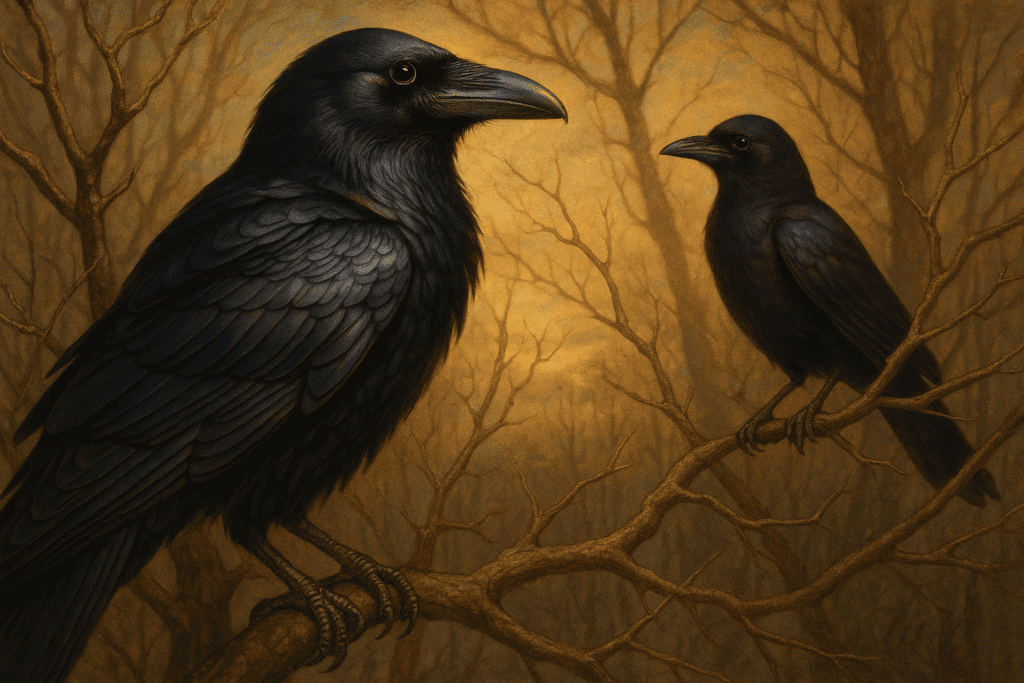
Before we get into the folklore, it helps to separate the two birds. In everyday speech, people often use “crow” and “raven” loosely, but in symbolism the distinction can matter.
- Crows are often associated with social intelligence, adaptability and mischievous problem-solving.
- Ravens tend to carry grander mythic weight, with links to prophecy, battle, memory and sacred knowledge.
- In folklore, crows are often the quick-witted neighbour; ravens are more likely to be the solemn seer.
That said, the overlap is huge. Both are black birds in folklore, both are intelligent, and both have long been treated as creatures at the edge of the ordinary world.
Common Themes in the Folklore of Crows and Ravens
Across cultures, a few themes appear again and again. These birds are often seen as signs of:
- Intelligence and sharp observation
- Messages from the spirit world or unseen realm
- Change, endings and new beginnings
- Trickery, wit and adaptive thinking
- Protection and watchfulness
- Death symbolism, though not always in a bleak way
It is worth saying plainly that “death” in folklore does not always mean literal death. More often it points to transition, the ending of one phase and the beginning of another. Nature, after all, is rarely sentimental about change.
Ravens in Mythology
Ravens have a particularly strong presence in world mythology. They are often linked to wisdom, battle, the divine and the power of seeing what others miss.
Norse raven lore
In Norse tradition, ravens are closely tied to Odin, who is famously accompanied by Huginn and Muninn, often interpreted as thought and memory. These ravens fly across the world and return with information, making them powerful symbols of intelligence, awareness and insight.
This is one reason raven symbolism often feels so weighty. The bird is not simply watching; it is understanding.
Celtic raven symbolism
In Celtic stories, ravens are frequently connected with battlefields, prophecy and the Otherworld. They can appear as ominous figures, but also as guardians of thresholds between worlds. In this setting, the raven is not merely a bad omen. It is a creature of sacred boundary and hidden knowledge.
Other raven myths
In several traditions, ravens are linked with creation stories, bringing light, fire or order into the world. In others, they are shape-shifters or divine messengers. The exact role changes, but the pattern remains: ravens stand close to mystery, power and meaning.
Crows in Mythology
Crows tend to appear as lively, cunning and surprisingly human in their behaviour. They are often cast as messengers, tricksters or practical survivors.
Indigenous and regional traditions
In some Indigenous traditions, crow stories carry deep cultural importance and should be treated with care and respect rather than generalised. In certain traditions, crows are linked to creation, transformation, humour and intelligence. In others, they act as messengers or teachers.
Because these stories vary so much, it is better to think of “crow symbolism” as a family of meanings rather than a single universal truth.
Trickster and messenger roles
Crows are often portrayed as the ones who notice everything, steal what they need and still manage to survive elegantly. That practical cunning is why they so often become trickster figures. They remind us that wit, timing and adaptability can be as valuable as strength.
In spiritual interpretation, seeing a crow may suggest that you need to pay attention, think differently or notice what has been hiding in plain sight.
Why Are Crows and Ravens Linked with Death and Magic?
There is a perfectly ordinary reason for part of this symbolism: both birds are scavengers as well as predators, so they are often seen around battlefields, roadkill or places of decay. Human beings are meaning-makers, so we naturally turn repeated encounters into stories.
But folklore adds another layer. Black birds in folklore often become symbols of the unknown. Their colour, call and behaviour make them feel liminal, as though they belong partly to this world and partly to another.
That is where magic enters the picture. If a bird seems able to cross boundaries, watch from a distance and survive almost anywhere, people begin to wonder whether it knows more than it lets on.
Positive Meanings: Wisdom, Protection and Transformation
It is easy to focus only on the darker associations, but that would miss much of the story. Crows and ravens can also symbolise:
- Wisdom gained through experience
- Protection through vigilance
- Transformation after loss or change
- Resourcefulness when life becomes difficult
- Spiritual insight or heightened intuition
For a modern reader, these birds can be a reminder that not every mysterious sign is a warning. Sometimes it is simply an invitation to notice more, trust your judgement and stay alert to opportunity.
Modern Uses in Books, Film and Spiritual Symbolism
Today, crows and ravens appear everywhere from gothic fiction to fantasy films and tarot-inspired imagery. They are used to suggest intelligence, atmosphere, foreboding or a character’s link to hidden knowledge. Writers and artists love them because they carry so much meaning with very little effort.
In modern spiritual language, people often see them as symbolic “checks in” from life: a prompt to reflect, pause or pay attention. That does not mean every bird is a mystical message, of course. Sometimes a crow is simply a crow, and a raven is simply being magnificently itself.
Quick Comparison: Crow vs Raven Symbolism
- Crow: clever, adaptable, mischievous, alert, messenger-like
- Raven: wise, mythic, prophetic, protective, boundary-crossing
- Shared meanings: mystery, transformation, intelligence, omens, magic
What the Folklore of Crows and Ravens Means for You
If these birds keep catching your attention, the most useful question is not “Is this good or bad?” but “What is changing here?” or “What am I being asked to notice?” Folklore works best when it helps us interpret the moment we are in, not when it traps us in superstition.
That is why crows and ravens remain so compelling. They are not only symbols of endings. They are symbols of awareness, adaptation and the strange, necessary intelligence that helps us move through change with our eyes open.
If you enjoy exploring symbolic signs, bird meanings and intuitive messages, this subject sits beautifully alongside astrology, tarot and personal reflection. Need a more personal answer? For guidance shaped around your own question, you can speak with one of Philip Garcia’s trusted psychic readers. Click on this link or call 0203 472 4377
Psychic and astrological content is provided for entertainment and personal insight. It should not replace professional medical, legal, financial or mental health advice.
Internal reading suggestions: If you would like to explore this theme further, a pillar article on bird symbolism in folklore, plus dedicated pieces on crow symbolism and raven symbolism, would sit neatly alongside this guide.
Frequently Asked Questions
What is the folklore of crows and ravens?
The folklore of crows and ravens often links them with intelligence, mystery, omens, messages and transformation. Ravens are especially associated with prophecy and wisdom, while crows are often portrayed as clever tricksters or messengers.
Are crows and ravens the same in folklore?
Not quite. Their meanings overlap, but ravens are usually treated as more mythic and prophetic, while crows are often seen as adaptable, mischievous and practical. The exact symbolism depends on the culture and story.
Why are ravens associated with death or magic?
Ravens are often linked with death and magic because they are black birds, they appear near battlefields or places of decay, and they have long been used in stories about prophecy, the Otherworld and hidden knowledge.
What do crows symbolise in folklore?
Crows commonly symbolise intelligence, cleverness, adaptability, messages and transformation. In some stories they are tricksters, while in others they act as guides or teachers.
Are crows and ravens good omens or bad omens?
They can be either, depending on the culture and context. In some traditions they are warnings; in others they are protective or wise. Folklore rarely gives one fixed answer.
For guidance shaped around your own question, you can speak with one of Philip Garcia’s trusted psychic readers. Click on this link or call 0203 472 4377
Psychic and astrological content is provided for entertainment and personal insight. It should not replace professional medical, legal, financial or mental health advice.


