

Why Young People Love Tarot: A Calm Look at the Trend
Why Young People Love Tarot: A Calm Look at the Trend
Why young people love tarot is a question that says quite a lot about the moment we are living in. Tarot has become more visible, more talked about, and a great deal more normal than it once was. For many younger people, it is not about dramatic fortune-telling or spooky certainty. It is about reflection, comfort, curiosity and a little sense of ceremony in an uncertain world.
Quick answer: young people love tarot because it offers self-reflection, emotional reassurance and a creative way to explore identity. Social media has made tarot easier to discover and share, while modern spirituality has made it feel less strange and more personal. In other words, it is part insight, part self-care, and part very stylish coping mechanism.
Why Young People Love Tarot

At its heart, tarot gives people a language for what they are already feeling. A card can be a prompt, a mirror or a gentle nudge. That makes it especially appealing to younger adults who are often navigating career changes, dating confusion, family pressure, money worries and the rather exhausting business of becoming oneself.
Tarot does not always need to be treated as a strict prediction system. For many young people, it works more like a reflective tool. It helps them pause, ask better questions and notice patterns in their thinking. That can feel far more useful than a blunt yes-or-no answer.
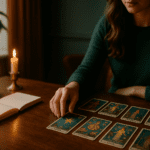
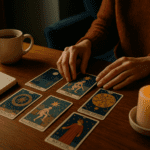
There is also something psychologically soothing about the ritual of it. Shuffling cards, focusing on a question, and reading symbols in a quiet moment can create a sense of order. Even if someone is semi-sceptical, they may still appreciate the pause.
Tarot as a Tool for Self-Reflection
One of the biggest reasons young people love tarot is that it suits the modern appetite for self-knowledge. Many are already used to journalling, therapy language, mood tracking and personality quizzes. Tarot slots neatly into that world because it invites interpretation rather than demanding blind belief.
A card such as The Hermit might make someone think about solitude, independence or burnout. The Two of Cups might prompt reflection on relationship patterns. The Tower might not feel like doom; it might simply be a useful reminder that change is already under way. The beauty is that the meaning often begins with the reader’s own life.
That is why tarot can feel surprisingly practical. It can help someone ask, “What am I avoiding?” or “What do I actually want here?” Those are not mystical questions so much as human ones.
Social Media’s Role in Tarot’s Popularity
Tarot on TikTok, Instagram and other social platforms has changed the way many young people encounter divination cards. A reading that once happened in a quiet room can now appear in a short, shareable clip with music, captions and a beautifully arranged deck.
This matters because social media makes tarot feel accessible. You do not need a strong background in occult history to notice a card pull, save a spread idea or follow a reader whose style feels calming. The online world has also made tarot look less hidden and less intimidating.
Of course, the algorithm has its own opinions. If someone watches one tarot video, they may suddenly be surrounded by many more. Yet even that can feed curiosity. People begin with a few reels or posts and then realise tarot has a whole language, community and rhythm of its own.
There is also the aesthetic side. The soft candlelight, the rich card imagery, the velvet pouches and the slightly mysterious mood all photograph rather well. And frankly, the internet has always liked a vibe.
Why Tarot Appeals to Gen Z Spirituality
Gen Z spirituality often looks different from older, more formal systems of belief. It is frequently eclectic, personal and open to mixing ideas. A young person may feel comfortable with astrology, tarot, meditation, crystals, journalling and psychology all in the same week. That flexibility is part of the appeal.
Tarot fits a generation that tends to value authenticity over authority. Many young people prefer meaning they can shape for themselves rather than a set of rules handed down from above. Tarot allows for that. It can be spiritual, symbolic, intuitive or simply reflective, depending on how it is used.
That does not mean every young tarot user believes every card is literally predictive. Some treat it as a wellness practice. Others enjoy it as a form of self-inquiry. Some are drawn to the mysticism. Others just like the pause before a decision. The point is that tarot leaves room for different levels of belief.
Tarot, Anxiety and Uncertainty
There is also a practical emotional reason why tarot resonates now. Young people are coming of age in a period that often feels unstable. Many are managing uncertain work, high living costs, constant comparison online and a general sense that the future is a moving target.
Tarot does not remove uncertainty, but it can make uncertainty feel more speakable. That is no small thing. A reading can turn vague worry into a clearer question. Instead of “Everything feels off”, someone may end up asking, “What do I need to pay attention to this week?”
This is where tarot can be quietly reassuring. It offers a small, contained ritual in the middle of a noisy day. That can be grounding, even for people who do not consider themselves particularly spiritual.
Is Tarot a Belief System or a Wellness Practice?
The honest answer is that it can be either, or neither, or a bit of both. Some young people use tarot as part of a wider spiritual path. Others see it as a symbolic wellness tool. Some simply enjoy the atmosphere and leave it there.
What matters is that tarot today is often less about rigid belief and more about personal meaning. A reading can become a conversation with the self. It can also be a way to slow down and look at a situation from a slightly different angle.
That may explain why tarot feels so modern. It is flexible. It allows ambiguity. And in a culture full of pressure to have everything sorted, ambiguity can be a relief.
The Aesthetic and Community Side of Tarot
Let us not pretend aesthetics do not matter. The design of tarot decks, the symbolism, the colours and the visual language all help make tarot appealing to younger audiences. It is tactile, expressive and easy to share.
Just as importantly, tarot creates community. Online and offline, people compare decks, discuss spreads, swap interpretations and talk about what a reading stirred up emotionally. That social aspect matters. Young people often want more than a solitary practice; they want something they can belong to.
In that sense, tarot is not only about what the cards say. It is also about who is talking about them, where the conversation is happening and how a person feels after the reading ends.
What This Trend Says About Young People Today
So, why young people love tarot may be less mysterious than it first appears. The trend says that many younger people want meaning without pretence, comfort without preachiness and spirituality that feels personal rather than prescriptive.
Tarot gives them a way to reflect, to imagine and to ask better questions. It also happens to look beautiful on a screen, which never hurts.
In the end, tarot’s appeal is not only mystical. It is human. It meets people in moments of doubt, hope and transition, and offers a language for all three.
If you would like to explore the subject further, you might also enjoy learning how tarot connects with astrology, or how to begin a tarot journal for personal reflection.
Need a more personal answer? For guidance shaped around your own question, you can speak with one of Philip Garcia’s trusted psychic readers. Click on this link or call 0203 472 4377
Disclaimer: Psychic and astrological content is provided for entertainment and personal insight. It should not replace professional medical, legal, financial or mental health advice.
Frequently Asked Questions
Why are young people drawn to tarot?
Young people are often drawn to tarot because it offers self-reflection, comfort, creativity and a sense of control during uncertain periods.
Is tarot mostly a spiritual practice for Gen Z?
For some, yes. For others, tarot is more of a wellness or reflective practice. Many young people use it in a flexible, personal way rather than as a fixed belief system.
Does social media make tarot more popular?
Yes. Social media has made tarot more visible, more shareable and easier to explore, especially through short readings, aesthetic decks and community posts.
Do young people believe tarot is always predictive?
Not necessarily. Many use tarot as a symbolic tool for insight and reflection rather than expecting absolute predictions.
For guidance shaped around your own question, you can speak with one of Philip Garcia’s trusted psychic readers. Click on this link or call 0203 472 4377
Psychic and astrological content is provided for entertainment and personal insight. It should not replace professional medical, legal, financial or mental health advice.